
The RAM Economy in Neuroscape

How Neuroscape's resource system works, and why it plays nothing like a land or mana crystals
Every trading card game needs a resource system, something that stops you from dropping your best card on turn one and slamming the door on the whole match. Magic uses lands. Hearthstone uses mana crystals. Most games since have borrowed one of those two templates and filed off the serial numbers. Neuroscape didn't. RAM is its own thing, and once you understand how it actually moves around the table, you'll see why it changes how the whole game plays.
RAM Isn't a Card in Your Hand
The first difference is structural. RAM lives in its own 25-card RAM deck, completely separate from your cyberdeck, and it is never drawn into your hand. You install it straight from that deck into your RAM bank during your draw/install step. That single design choice already rules out two of the most common frustrations in resource-based card games: you can't get mana screwed by drawing the wrong pile of cards, and you can't flood out on lands because RAM was never competing with your hand for space in the first place.
Once installed, a piece of RAM sits in your bank until you spend it. Spending RAM means running it, turning the card 90 degrees to show it's been used. Every refresh step of your turn, any running RAM in your bank stands back up automatically, ready to be spent again. So far, this is roughly comparable to tapping a land for mana. What comes next is where Neuroscape stops looking like anything else on the shelf.
The Draw/Install Step Is One Budget, Not Two
In most resource-based TCGs, drawing your card for turn and gaining your resource for turn are two separate, guaranteed events. Not in Neuroscape. Your draw/install step gives you exactly two cards total, and you choose the mix: two RAM, two cards from your cyberdeck, or one of each. Card effects can install extra RAM beyond that budget, but the baseline is a single shared pool you have to allocate every single turn.
That single decision point is a real strategic lever the moment you sit down to play. Fall behind on RAM and you can't deploy your hand. Fall behind on cards and you run out of gas. Every turn asks you to choose, and the choice changes based on your hand, your board, and what you're trying to do that turn.
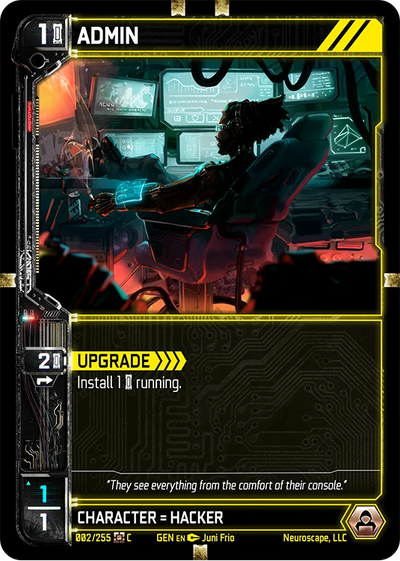
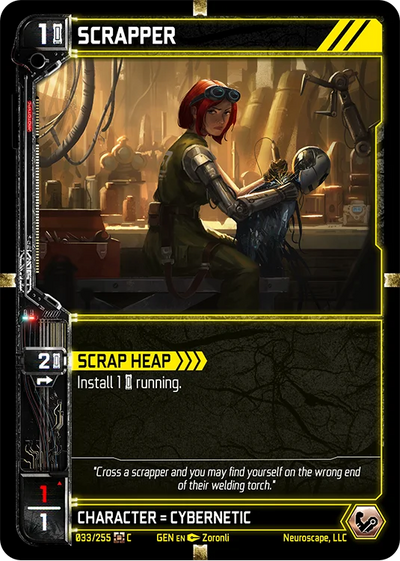
Admin and Scrapper both read the same simple line: Install 1 RAM running. Cheap Characters like these are how Neuroscape decks buy their way out of the shared draw/install budget, effectively getting extra RAM on top of what your normal turn already gives you. In a game where every turn forces a real choice between cards and resources, a one-cost Character that hands you a free RAM install is quietly one of the strongest kinds of card the format has to offer.
Committed RAM: Paying to Keep the Lights On
Here's the part that has no real equivalent in Magic or Hearthstone (its closer to Pokémon in some ways). When you spend RAM on a Character, that RAM doesn't just get tapped and refresh next turn like a land would. It physically leaves your bank and moves to sit underneath the Character it paid for, where it stays committed for as long as that Character remains in play. If the Character leaves the battlefield, its committed RAM returns to your bank, running/tapped, refreshing on your next turn like normal.
This turns every Character on your board into an ongoing resource commitment, not a one-time purchase. Your board isn't just a collection of stats; it's a physical record of where your RAM currently lives. A wide board of Characters means a lot of your RAM is locked in place holding your existing threats together, which is exactly why cards that ramp extra RAM into your bank, or that punish an opponent for over-committing, are such a fundamental part of deckbuilding here. On the flipside, boards with fewer charachters have more RAM to spend on programs, gear, and combat tricks.
Force Quit: Cutting Your Losses on Purpose
Every initialize phase includes a step called Force Quit, and it's the only moment in the entire game where you're allowed to destroy your own Characters, Programs, or Gear voluntarily. It sounds like pure downside until you remember what happens to committed RAM when a Character leaves play: it goes back to your bank. Specifically, RAM freed by a Force Quit returns refreshed and ready rather than running, meaning you can spend immediately, not waiting for your next refresh step.
That makes Force Quit a genuine tempo tool instead of just a loss. A Character that's done its job, or one you can no longer afford to keep committed to, can be cut on your own terms to bankroll something better the same turn. No other major TCG builds a scheduled "cut your losses" window directly into the turn structure the way Neuroscape does.
Instability: What Happens When You Can't Pay
This is the mechanic that makes Neuroscape's RAM economy feel genuinely dangerous in a way land screw or an empty mana pool never quite manages. At the very top of your turn, during the system check, the game asks one question: is every Character you control fully paid for in committed RAM? If an effect has raised a Character's cost, or committed RAM was pulled away from it and there wasn't enough left in your bank to cover the difference, your mainframe becomes unstable.
An unstable mainframe doesn't just lock you out of playing new cards the way running out of mana does elsewhere. It puts your entire board at risk. You roll a d20 for every single Character and Program you control, starting with your cheapest and working up. Roll 0 through 10, that card crashes and is destroyed. Roll 11 through 20, it survives. Being unable to pay for one underfunded Character can put your whole board on the chopping block, card by card, die roll by die roll.
Compare that to Magic, where missing a land drop just means you play fewer things that turn, or Hearthstone, where an empty mana pool means the same thing next turn. Neuroscape turns a resource shortfall into an active, immediate threat to everything you've already built. It's the sharpest possible incentive to never let your RAM economy get away from you and we foresee a future deck archetype that targets RAM for removal more often.
How This Stacks Up Against Other TCGs
| System | Where it lives | What happens if you fall behind |
|---|---|---|
| Magic: The Gathering (lands) | Shuffled into your deck, drawn into hand | You miss land drops and simply play fewer spells |
| Hearthstone (mana crystals) | Gained automatically, one per turn, no card involved | You're capped at a lower mana total that turn |
| Neuroscape (RAM) | Its own 25-card deck, installed via a shared draw/install budget | Your mainframe goes unstable and your board rolls dice to survive |
The fixed 25-card RAM deck alone already removes a huge amount of the variance that defines land-based games like Magic (the designers have even hinted at rare or non-basic lands that have additional abilities!). But the real departure is what RAM does once it's in play: it commits to specific cards, it can be voluntarily freed through Force Quit, and failing to keep it balanced turns into an active, randomized threat to your board rather than a passive tempo loss.
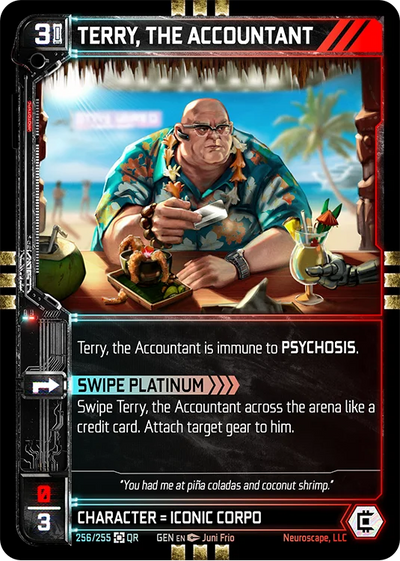
Terry, the Accountant is a good reminder that not every card in this economy is about RAM directly. He lets you swipe attached Gear across the arena like a credit card, moving value around your board without touching RAM at all. Knowing when to lean on effects like this instead of committing more RAM to your board is exactly the kind of decision Neuroscape's resource system is built to reward.
What This Means for Deckbuilders
If you're building your first Neuroscape deck, treat RAM ramp Characters like Admin and Scrapper as genuinely premium commons rather than filler. Getting ahead of the shared draw/install budget early snowballs hard in a game where every turn already forces a choice between cards and resources.
Pay close attention to how many Characters you're keeping committed to at once. A wide board looks strong, but every Character on it is RAM your bank can't use for anything else, and any effect that raises costs or strips committed RAM is pushing you toward an instability check you don't want to take.
And don't sleep on Force Quit. Holding onto a Character that's already done its job, purely out of reluctance to lose board presence, can cost you the tempo you need to close out a game. Sometimes the strongest play in Neuroscape is cutting your own card on purpose in order to play a huge finisher.
Ready to build a deck around a resource system unlike anything else on the shelf? Browse our full Neuroscape singles collection at RAMChannel.com.