Card Types in Cyberpunk TCG

Legend, Unit, Program, and Gear: here's what every card in your crew actually does
Every card in Cyberpunk TCG falls into one of four types, and knowing the difference is the first step to actually building a crew instead of just shuffling a pile of cards. Each type plays a distinct role on the table, follows its own rules for when and how it enters play, and reads a little differently once you know what to look for. Here's a full breakdown of every card type in the game, plus how to spot Timing Triggers and Keywords once you're actually reading the cards in front of you.
So how do you know what type a card is? Look at the top-right corner of any card and you'll find its type printed plainly, alongside the card's cost and RAM value. From there, the layout of the card (where the stats sit, whether it has a Power number, whether it has an Eddies sell tag) tells you everything else you need to know before you even read the rules text.
Legend
Legends are the centerpiece characters of your crew, and every deck runs exactly 3 of them, each with a unique name. They start the game face-down and shuffled into a random order in your Legends area, and you reveal one at a time by spending 1 €$ to Call a Legend, once per turn. Face-down or face-up, a Legend can always be spent as 1 €$, so even the ones you haven't flipped yet are pulling weight.
Legends set the RAM ceiling for your whole deck. Their colored border and RAM value determine how strong a card of that color you're allowed to run, so your choice of Legends shapes your entire deckbuilding plan before you've placed a single Unit.
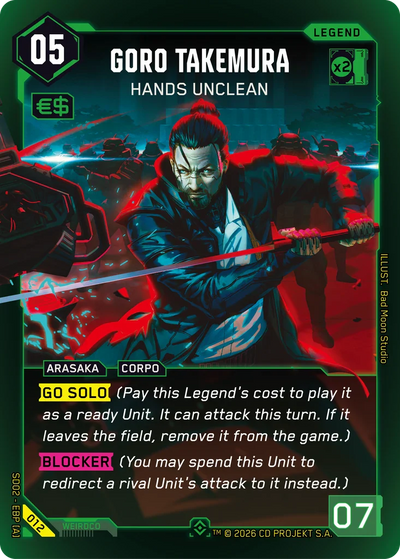
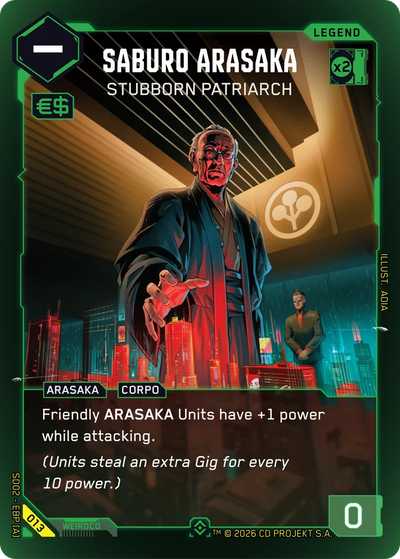
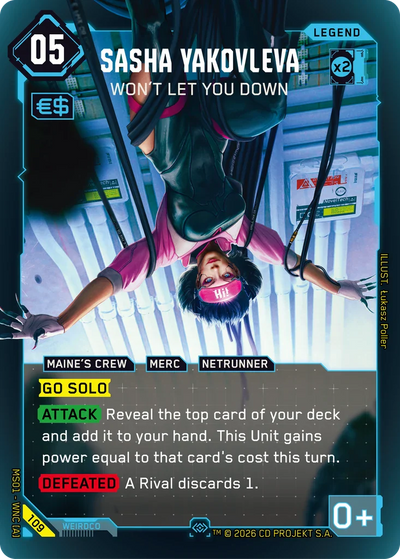
Some Legends, like Goro Takemura — Hands Unclean, also carry the Go Solo keyword, which lets you pay their cost to drop them into the field as a ready Unit instead of calling them the normal way. Sasha Yakovleva — Won't Let You Down does the same thing, turning a Legend that would otherwise sit face-down into an immediate threat.
Unit
Units are the muscle of your crew. You pay their cost, put them in the field, and they're ready to start fighting for you. There's one catch: new Units enter the field with Lag, meaning they can't attack or use self-spend abilities until your next turn, unless they carry the Adrenaline keyword that lets them skip the wait entirely.
Units are what steal Gigs, trade blows with rival Units, and carry most of the Attack and Defeated triggers you'll build a strategy around.
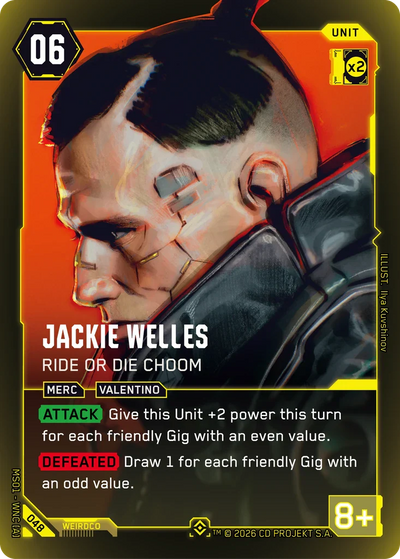
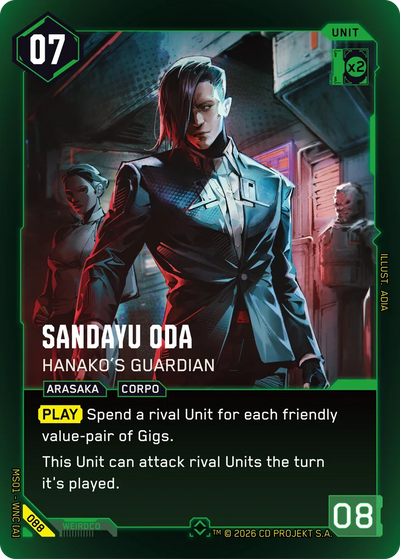
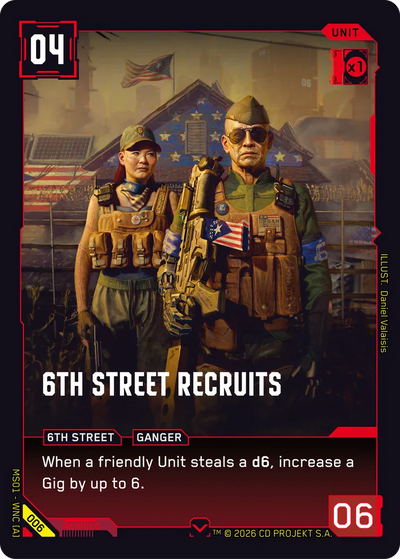
Jackie Welles — Ride or Die Choom shows off a Unit's Attack and Defeated triggers working together, scaling with your Gig count no matter how the fight goes. Sandayu Oda — Hanako's Guardian can attack the same turn it's played thanks to a built-in exception to Lag, making it a rare tempo play straight out of hand. And 6th Street Recruits is proof that even a cheap common Unit can carry real value once it starts stealing Gigs.
Program
Programs are one-shot effects. You pay the cost, resolve whatever the card says, and it heads straight to the trash afterward. There's no board presence to manage and nothing left behind once it resolves, just a single burst of value at exactly the moment you need it.
Some Programs carry the Quick keyword, which lets you play them as a reaction the instant a rival Unit attacks, rather than waiting for your own turn. That makes Quick Programs some of the best tools in the game for disrupting a rival's plans before they finish paying off.
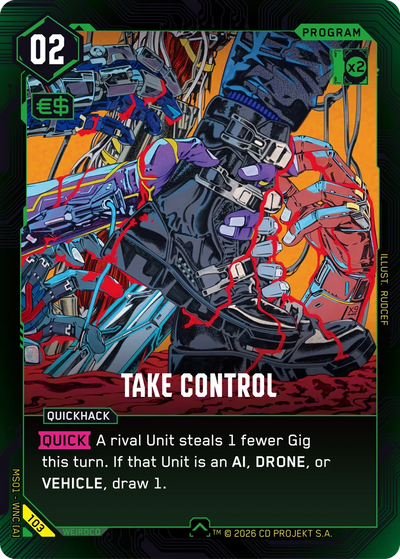
Take Control is a great example of a Quick Program in action: you hold it in hand until a rival attacks, then fire it off as a reaction to blunt what would otherwise be a clean hit.
Gear
Gear is equipment. You pay the cost, attach it to a friendly Unit or a face-up Legend, and it sticks around, granting a stat boost or an entirely new trick for as long as it stays equipped. Unlike Programs, Gear doesn't resolve and vanish; it becomes a permanent part of whatever it's attached to until that card leaves play.
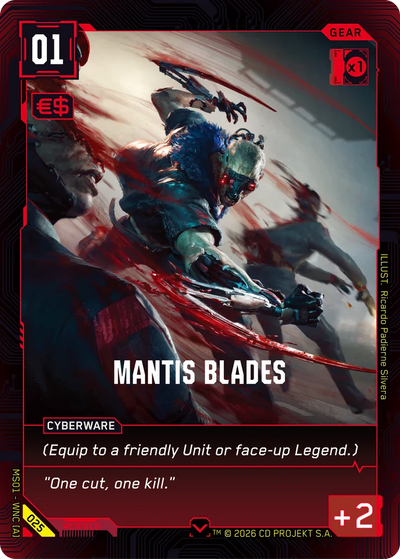
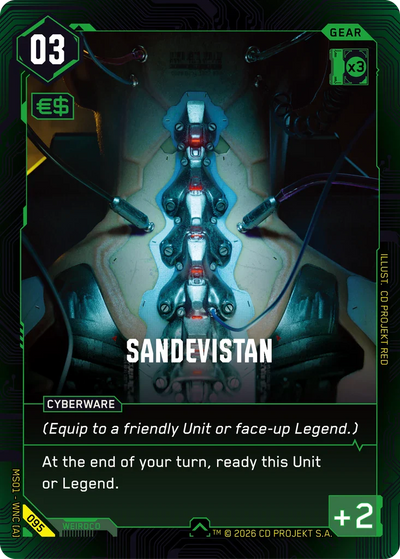
Mantis Blades equips straight onto a friendly Unit or face-up Legend for a straightforward combat upgrade, while Sandevistan readies its equipped card at the end of your turn, effectively banking you an extra action for later. Gear like this rewards you for protecting your board instead of just racing to spend everything in hand.
Reading the Rest of the Card
Once you know a card's type, two more visual systems tell you how it actually plays:
Timing Triggers are shown as convex (curved outward) pills on the card, and they tell you when an effect happens: on Play, on Call, on Attack, or on Defeated. Attack triggers are marked green and Defeated triggers are marked red, drawing on the familiar "go" and "stop" color association so you can read a card's timing at a glance.
Keywords are shown as concave (curved inward) pills, and they highlight a standardized effect shared across multiple cards, like Adrenaline, Blocker, Go Solo, and Quick. Quick and Blocker keywords are highlighted in bright pink specifically because both can be used during the React step after a rival's attack, so that color becomes your visual cue to stop and consider a response.
Both systems were designed with colorblind accessibility in mind, using shape as well as color so you're never relying on a single visual cue to read a card correctly.
Card Types at a Glance
| Type | Enters Play | Leaves Play | Notes |
|---|---|---|---|
| Legend | Called or Go Solo | Stays in Legends area or field | Exactly 3 per deck, sets your RAM limit |
| Unit | Played to field | Trash, when Defeated | Enters with Lag unless it has Adrenaline |
| Program | Played, resolves | Trash, immediately after resolving | Quick Programs can be played as a reaction |
| Gear | Played, equips | Trash, when the equipped card leaves | Stays attached until it or its host is removed |
What Does This Mean for Deckbuilders?
If you're just starting out, spend your first few games paying attention to which type each card in your hand is before you even read the rules text. Knowing you're holding a Unit versus a Program changes what "playing" that card actually accomplishes, and that instinct will make every other rule click faster.
If you're building your first crew, remember that your 3 Legends do double duty: they're both playable cards in their own right and the RAM foundation for everything else in your deck. Choosing Legends with Go Solo or strong Call effects can shape your whole game plan around getting them into play early.
And if you're optimizing an existing deck, look hard at your Gear and Program slots. Gear rewards a board you intend to protect, while Programs (especially Quick ones) reward flexibility and reactive play. The right balance between the two often separates a deck that just plays cards from one that's actually built to win.
Browse our full Cyberpunk TCG singles collection at RAMChannel.com to start building your crew today.