
Cyberpunk TCG Rarity Guide

From bread-and-butter commons to Nova Rare chase cards, here's what to know about card rarity in Cyberpunk TCG
The Welcome to Night City set is Cyberpunk TCG's first retail release, and it's packed with cards pulled from across the games, the TTRPG, and Edgerunners. But not every card is equally easy to find. Whether you're cracking booster packs, hunting singles on RAM Channel, or just trying to figure out why one Goro Takemura card looks so different from another, understanding the rarity system will save you time, money, and confusion. Here's a breakdown of every rarity tier in the game.
So how do you know what rarity a card is? Look at the bottom center of the card for the rarity icon. On top of that, the game's foil treatment scales with rarity: commons and uncommons are printed non-foil, while every rare-or-better card gets foil, and the higher the rarity climbs, the heavier the foil, texturing, and stamping gets. The whole system was also built to be colorblind-accessible, so you're never relying on a subtle color shift alone to tell your commons from your chase pulls.

Common
Commons are the backbone of the set and the cards you'll see most often. Each Welcome to Night City booster pack contains 7 commons, more than half the pack. Don't let that low rarity fool you, though. Plenty of commons carry real weight in constructed play; a well-costed common Unit or a clean removal Program can anchor a deck just as easily as a splashy rare.
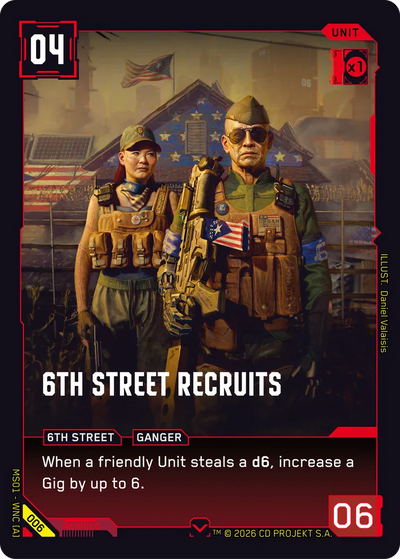
6th Street Recruits is a good example of a common doing honest work: a cheap Unit with a Gig-boosting ability that fits into almost any aggressive shell. For budget builders, commons are where you start, and often where you finish.
Uncommon
Uncommons sit a tier above commons in both scarcity and power ceiling. Each pack includes 3 uncommons, making them noticeably harder to pull than commons but still a regular sight. This is often where you'll find your solid Gear pieces, flexible Programs, and Units that punch a little above their cost.
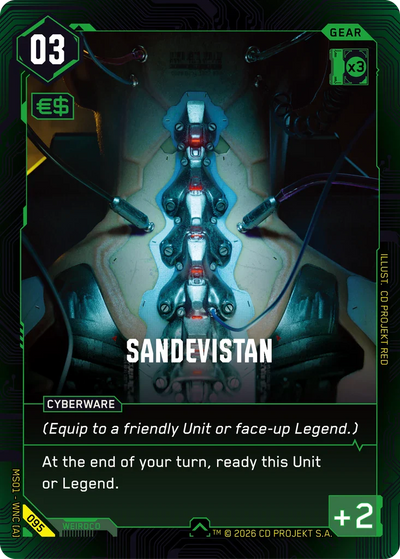
Sandevistan is a great uncommon pull: cheap Gear that readies its equipped Unit or Legend at the end of your turn, giving you an extra attack or an extra layer of defense. Cards like this rarely headline a deck, but they show up in playsets across a huge range of strategies.
Rare
Every Welcome to Night City booster pack has 2 slots reserved for Rare-or-better cards, so this is where packs start to get exciting. Rares tend to be your strong Units, your build-around Legends, and your high-impact Programs. They're powerful enough to build a strategy around, but common enough that competitive players can put together full playsets without emptying their wallets.
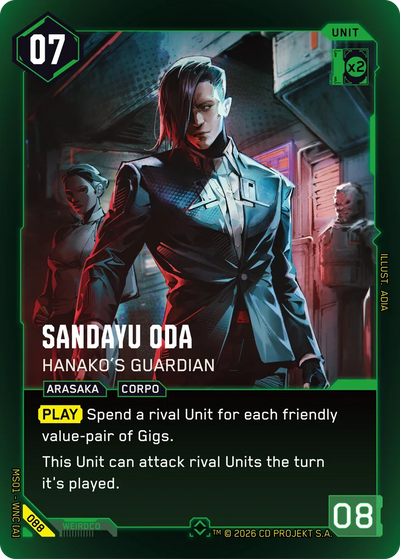
Sandayu Oda — Hanako's Guardian shows what a rare brings to the table: a Unit that can remove a rival threat the turn it's played, which is exactly the kind of tempo swing that earns a card its foil treatment.
Epic Rare
Epic Rares share that same rare-or-better pack slot but show up less often, and they're where the set's biggest personalities tend to live. Legends, high-cost Units, and game-warping Gear all show up at this tier. If a card is built to be the centerpiece of your crew, there's a good chance it's an Epic Rare.
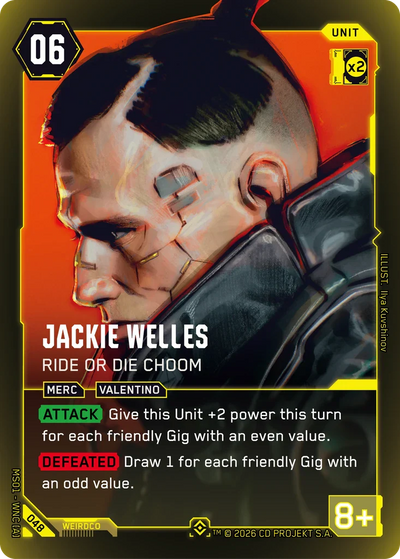
Jackie Welles — Ride or Die Choom is a textbook Epic Rare: a Unit whose Attack and Defeated triggers both scale off your board state, rewarding you for building around him specifically rather than just slotting him into any deck.
Secret Rare
Secret Rares are rarer still, and they typically carry some of the flashiest character-defining effects in the set. These cards aren't necessarily more powerful than an Epic Rare on paper, but they're pulled far less often and tend to command a real premium on the singles market once the game hits retail shelves.
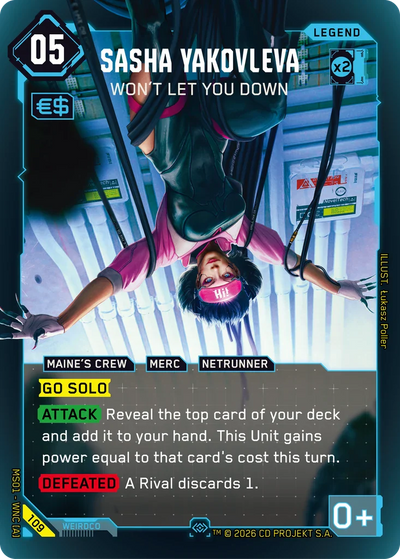
Sasha Yakovleva — Won't Let You Down is a Secret Rare Legend with Go Solo, meaning you can drop her straight onto the field as a ready Unit. Between her card advantage on Attack and the discard she forces on Defeated, she's exactly the kind of card that makes cracking a pack feel like an event.
Iconic Rare
Iconic Rares are alternate-art versions of existing cards. The rules text underneath stays identical to the standard printing, but the artwork is reworked or extended, making these purely a collector's chase rather than a competitive upgrade. Johnny Silverhand — Rocking Renegade is the most talked-about example revealed so far, with an Iconic Rare treatment that's already turning heads at conventions. These pulls sit above Secret Rare in scarcity and are the kind of card you frame more often than you sleeve up for a match.
Nova Rare
This is where things get seriously exclusive. Nova Rare sits outside the standard booster pack rarity structure entirely; you won't pull one from a regular pack. Instead, Nova Rares are reserved for Kickstarter rewards, convention exclusives, and other special promotional releases. Some, like the promo Rebecca card, even come in both foil and non-foil versions depending on how you earned them.
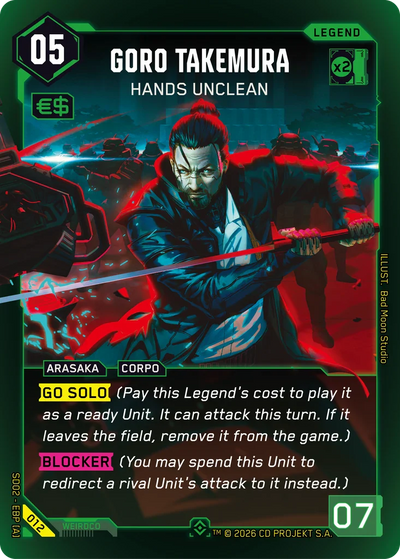
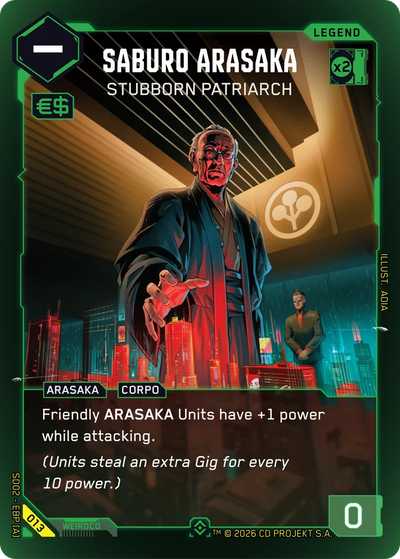
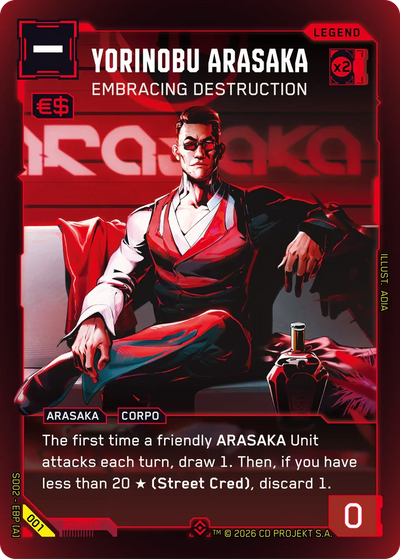
Goro Takemura — Hands Unclean, Saburo Arasaka — Stubborn Patriarch, and Yorinobu Arasaka — Embracing Destruction are all Nova Rare printings of their respective Legends, distinct from the standard Rare and Epic Rare versions of the same characters found elsewhere in the set. Pulling one of these isn't really about luck of the draw; it's about being in the right place at the right time.
Other Rarity Considerations
Box Toppers
A box topper isn't a card rarity so much as a bonus. Certain Kickstarter stretch goals added a random promotional card to every Beta Booster Display, on top of the 24 packs already inside. It's not something you'll find in every booster display going forward, but early adopters got a little something extra baked in.
Beta Symbol Cards
Anything that shipped through the Kickstarter campaign, whether a starter deck or a booster display, carries a small Beta symbol that retail products won't have. Kickstarter products also include exclusive art variants not found anywhere else. If you spot that Beta marking on a card, you're holding something from the earlier print run that won't be reprinted the same way again.
Promo Cards
Promos live outside the standard rarity ladder entirely. Starter decks each include 5 mechanically unique cards exclusive to that specific product. Convention demo sessions have handed out exclusive full-art Nova Rare cards like Rebecca — Having a Moment. And anyone who signed up early or backed at the right tier got their hands on a Nova Rare Lucy card, foil or non-foil depending on timing. Promos are generally legal for competitive play, just limited in how you can actually get one.
Rarity at a Glance
| Rarity | Per Pack | Notes |
|---|---|---|
| Common | 7 | The backbone of every deck |
| Uncommon | 3 | Solid support, Gear, and utility Programs |
| Rare | Shares 2 rare+ slots | Build-around Units, Legends, and Programs |
| Epic Rare | Shares 2 rare+ slots | Bigger, splashier centerpiece cards |
| Secret Rare | Shares 2 rare+ slots | Rarer pull, real premium on singles |
| Iconic Rare | Rare pull | Alternate art, same rules text |
| Nova Rare | Not in packs | Kickstarter and convention exclusive |
What Does This Mean for Buyers?
If you're playing competitively, you'll mostly care about Rares, Epic Rares, and the occasional Secret Rare. Since the singles market for Cyberpunk TCG is just getting started, buying exactly the copies you need is going to be a lot more efficient than cracking case after case hoping to hit a playset.
If you're collecting, Iconic Rares and Nova Rares are your endgame. With the game moving from Kickstarter into full retail later this year, now is the time to get familiar with what's out there before the secondary market really takes off.
And if you're just getting started, don't sleep on commons and uncommons. They'll carry your first few decks a lot further than you'd expect, and the rares will come naturally as you keep playing.
Browse our full Cyberpunk TCG singles collection at RAMChannel.com to find exactly the cards you need for your crew.