Deckbuilding in Neuroscape
 Building Your First Neuroscape Deck
A beginner's guide to constructing a cyberdeck
So you've decided to jack into the simulation. Welcome. Building Neuroscape decks is one of the most rewarding parts of the game. It's where strategy meets personality and where your playstyle starts to take shape. Let's walk through everything you need to know to get started.
What Goes Into a Deck?
Before you start pulling cards, know what you're actually building. Every constructed Neuroscape deck requires three components:
- A Mainframe - your neural computer. One card, lives in its own zone.
- A Cyberdeck - your main deck of 50 to 255 non-RAM, non-mainframe cards.
- A RAM Deck - exactly 25 RAM cards. No more, no less.
You can also bring a sideboard of up to 12 non-RAM cards and one additional mainframe for multi-game matches, but don't stress about that when you're first starting out.
The 4-copy rule applies across your cyberdeck and sideboard combined (no more than 4 copies of any single card total).
Start With Your Mainframe
This is the most important decision you'll make. Your mainframe isn't just a health tracker. It has synergy effects that fire based on two conditions: how many cards you have in play, and how much faction synergy you've built up.
For example, a Cybernetic mainframe might reward you for having 2 or 4 Cybernetic-faction cards on the board. If you pick a mainframe that rewards Hacker synergy but then fill your deck with Mystic characters, your synergy effects will never activate.
The lesson: pick your mainframe first and let it guide the rest of your build.


Choose Your Faction (or Two)
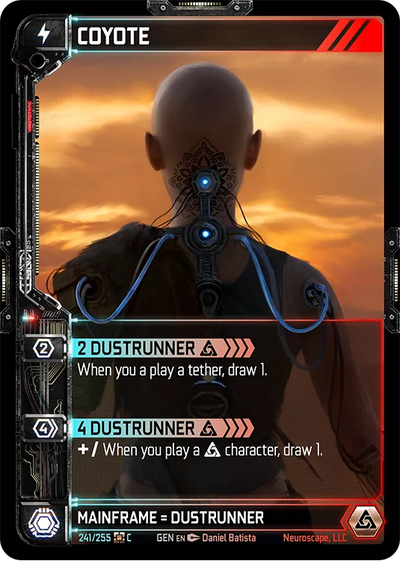
Most characters, gear, and some programs belong to a faction, shown by the icon in the bottom-right corner of the card. Persistent cards in play contribute synergy toward their faction, which unlocks your mainframe's power tiers.
You don't have to go mono-faction. In fact, some characters have dual faction icons and count toward both. However, spreading too thin means your synergy effects may never come online. Early on, keep it simple and focus on one or two complementary factions.
Build Around Characters
Characters are normally your primary path to victory. They attack, block, and activate abilities. When building your character suite, keep a few things in mind:
Red vs. Blue attack values matter. Red attack damages your opponent's bioframe; blue hits their mainframe. Both health pools start at 20, and either hitting zero is GG. Most decks tend to focus on one type of damage to efficiently burn down their opponent.

RAM cost shapes your curve. You install up to 2 RAM per turn and commit that RAM to characters. A deck full of 5 and 6-cost characters will sit in your hand forever early game. Mix cheap characters you can deploy early with powerful late-game threats.
Gear Ports are real estate. Characters have up to four gear ports: Head, Left Arm, Right Arm, and Body. If you're planning a gear-heavy strategy, make sure your characters have the right port types and levels to support the gear you want to run.
Gear: Augment Your Arsenal
Gear attaches to characters and gives them stat boosts or new activated abilities. A few important things:
- Gear port levels must match. A Level 2 arm port on a character can accept Level 1 or Level 2 arm gear, but not Level 3.
- RAM doesn't need to be committed to gear (it's a one-time cost to play).
- If a character leaves play, all attached gear is destroyed with it.
Watch out for Psychosis gear. Cards with the PSYCHOSIS keyword give your character a psychosis value, and whenever that character attacks or activates an ability, you roll a d20. Roll under their total psychosis and the character hits you instead. High-risk, high-reward so plan accordingly.
There's also Malicious gear, which can be attached to any character, including your opponent's. These typically apply negative effects. Sneaking a Neural Disruptor onto a key enemy character can completely change a game.
Programs: Scripts, Protocols, and More
Programs cover everything from one-time spells to persistent battlefield effects. Like gear, RAM does not need to be committed to Programs.
Scripts are your instants and sorceries. Most are played during your Deploy phase, but anything with the SWIFT keyword can be played during swift checks on any player's turn (essentially at instant speed). Load up on SWIFT scripts if you want to stay reactive.
Protocols are persistent programs that attach to your mainframe (which has three slots). They provide ongoing passive effects, but once all three slots are filled, you can't play more until one clears. Think carefully about which protocols are worth the slot.
Viruses are protocols that attach to any player's mainframe (including your opponent's) and deal ongoing damage or penalties. Great in aggressive or damage over time (DOT) strategies.
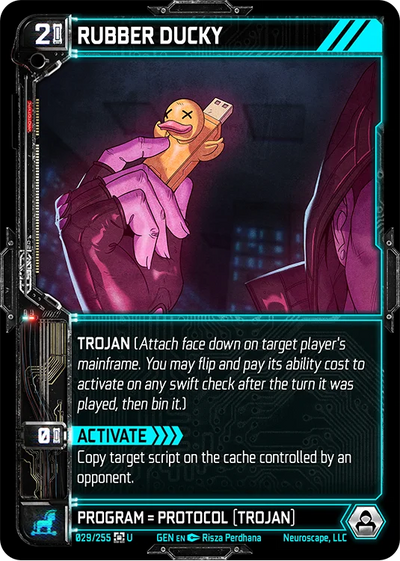
Trojans are sneaky face-down protocols you place on any mainframe slot. Your opponent doesn't know what it does until you flip and activate it on a later swift check. Bluffing and mind games are very much part of the Trojan strategy. Think of these like trap cards in Yu-Gi-Oh.


Don't Forget the Cache (aka the "stack")
Neuroscape uses a Last In, First Out (LIFO) cache system (like a stack in MTG). When you play something, it enters the cache and a swift check opens for responses. The last thing played resolves first. This means:
- Your opponent can respond to your cards before they resolve.
- You can respond to their responses.
- Activated abilities still resolve even if the character is destroyed mid-cache, because once an ability enters the cache, it's independent of its source.
Understanding the cache isn't just rules knowledge, it's the difference between a good player and a great one. Build your deck with this in mind: counterspell effects, swift damage, and ability-interruption tools are all more valuable than they first appear.
Quick Deckbuilding Checklist
Before you finalize your list, run through this:
- Does my mainframe's synergy support the factions I'm running?
- Do I have enough low-cost characters to play early turns?
- Are my character gear ports compatible with the gear I want to run?
- Do I have SWIFT cards for reactive plays?
- Is my RAM deck exactly 25 cards?
- Is my cyberdeck at least 50 cards?
- Am I running no more than 4 copies of any card across my deck and sideboard?
Final Thoughts
There's no single "correct" way to build a Neuroscape deck. Aggro strategies that flood the board with cheap characters play completely differently from a Mystic tarot deck that generates tokens and controls the pace of the game. Experiment, iterate, and don't be afraid to get weird with it.
And remember: Rule #1 is have fun. The best deck is the one you enjoy piloting.
Now go build something dangerous.